
Epoxy vs Polyaspartic vs Polyurea: Which Is Right for a Minnesota Garage?
Short answer: most Minnesota garages are best served by a system that uses more than one of these coatings. A strong floor pairs an epoxy or polyaspartic base coat with a full flake broadcast and a polyaspartic topcoat. Epoxy grips ground concrete and has the lowest starting price per square foot in a national cost guide.
Polyaspartic resists UV yellowing and cures faster, and some grades go down on cooler slabs than standard epoxy. Pure polyurea stretches the most and sets the fastest, but it takes special spray equipment to apply. We install all three as parts of one system, shown on our polyaspartic and polyurea floor coatings page.
What is the difference between epoxy, polyaspartic and polyurea?
All three are two-part coatings that harden by chemical reaction. Epoxy is a resin and a hardener that bond hard to clean, ground concrete. In one flake system’s adhesion test, the concrete broke before the epoxy bond let go. Its weak spot is sunlight: epoxy data sheets warn that it ambers and chalks under UV light.
Polyurea is an elastomer, a rubbery material made from an isocyanate and an amine resin blend. Pure polyurea reacts so fast that it is hard to apply without plural-component spray equipment. One spray grade is dry to the touch in 15 seconds.
One polyurea floor base coat goes on with a roller and is ready to scrape flake in about 1.5 hours. Aromatic grades change color in sunlight, while aliphatic grades hold their color.
Polyaspartic is a type of aliphatic polyurea. Flooring makers use it because it resists the UV yellowing that affects aromatic polyurea. It hardens a little slower than pure polyurea, which gives installers time to squeegee and roll it. That window is still short: one data sheet lists a pot life of 15 to 30 minutes.
How do epoxy, polyaspartic and polyurea compare?
Here is how the three stack up on published data sheets and one national cost guide. The data sheet for each coat on your floor is what counts.
| Epoxy | Polyaspartic | Polyurea | |
|---|---|---|---|
| Cure time | Foot traffic in 12 to 24 hours; vehicles in 2 to 7 days; full cure about 7 days | Fast grades: foot traffic in 4 to 6 hours; vehicles in 1 to 2 days | Base coat: ready for the flake scrape in about 1.5 hours; spray grade: touch dry in 15 seconds |
| UV stability | Ambers and chalks in sunlight unless covered | UV stable; resists yellowing | Aromatic grades change color; aliphatic grades hold color |
| Flexibility (elongation) | Stiff: 6 to 20 percent; one sheet says it will not bridge cracks | Varies: 5 to 40 percent | Elastomer: 450 percent on one spray grade |
| Cold-weather application | Many sheets set a 50°F minimum; cure slows in the cold | Some sheets allow slabs down to 35°F to 40°F | One flake system allows 35°F slabs; one spray grade allows minus 20°F |
| Cost tier, installed per square foot | $4 to $10 | $5 to $12 | $5 to $10 |
| Where it fits | Base coats, moisture primers, metallic floors | Topcoats, one-day flake systems, outdoor slabs | Fast base coats in one-day flake systems, spray linings |
Cure times are for room temperature, about 68°F to 77°F. Costs are installed prices per square foot from one national cost guide. They are market numbers, not our price list.
Why does a Minnesota garage change the answer?
Cold slabs. Minnesota DNR climate normals put the Twin Cities’ average daily temperature below 50°F from mid-October to about April 20. An unheated garage slab can stay cold through much of that stretch.
Many epoxy data sheets set 50°F as the lowest air and slab temperature, and one asks for 59°F. Cold slows the cure too. One epoxy primer needs about 2 days before foot traffic at 50°F, versus about 1 day at 68°F.
Polyaspartic gives more room. One data sheet allows air and slab temperatures down to 35°F with its fast-cure grade, and another lists 40°F. The same maker rates its one-day flake systems, epoxy or polyurea based, for 35°F slabs with that fast-cure topcoat. Every layer has to fit the temperature, from base coat to topcoat.
Data sheets for all three chemistries also require the slab to sit at least 5°F above the dew point. One maker notes that its polyaspartic cures faster with moisture in the air. Humid summer days shorten the working time.
Which coating handles sun, salt and slab movement?
Sun reaches a garage floor through an open door, and porches and patios get far more. Polyaspartic is the UV-stable choice for those spots. One maker warns that its epoxy and polyurea base coats both yellow where flake does not cover them.
The Minnesota Pollution Control Agency estimates 365,000 tons of road salt go down in the Twin Cities metro each year. Ready-mix concrete guidance says to hose off the salt that cars leave on garage slabs. On one polyaspartic data sheet, 20 percent salt water scores excellent for chemical resistance, as do motor oil and gasoline.
Concrete expands and shrinks as temperatures swing, and a national cost guide rates polyaspartic more flexible than epoxy. Data sheets overlap, though. The epoxy data sheets we checked list 6 to 20 percent elongation, and the polyaspartic ones 5 to 40 percent.
Polyurea is in a different class, at 450 percent elongation on one spray grade. Still, one flake-system guide warns that moving joints and shrinkage cracks may show through the coating. That is one reason we repair cracks and pits before any coating goes down.
Is epoxy still a good choice?
Yes, in the right layer. Epoxy bonds hard to diamond-ground concrete, and a national cost guide puts it at the low end on price. It also tolerates more slab moisture than some fast base coats.
On the ASTM F1869 moisture test, one maker’s epoxy base coat allows up to 12 pounds of vapor. Its polyurea base coat allows 3. Epoxy is also used in moisture-control primers made to hold back vapor rising through a slab.
Metallic floors rely on epoxy too, with metallic pigments worked through clear epoxy. Its limit is sunlight. In a garage, the epoxy base coat goes under full flake and a UV-stable polyaspartic topcoat. Read more on our epoxy floor coatings page.
What do epoxy, polyaspartic and polyurea cost?
A national cost guide lists installed epoxy garage coatings at $4 to $10 per square foot. That is about $1,600 to $5,800 for a typical two-car garage. The same guide puts polyurea at $5 to $10 per square foot, or about $2,000 to $5,800.
Polyaspartic runs $5 to $12 per square foot, or about $2,000 to $6,900 for two cars. These are market numbers, not our price list.
A system that mixes chemistries will not match one line. Slab repairs, the moisture test and square footage move the price too. For the full picture, read our Minnesota garage floor coating cost guide.
How do we choose the system for your floor?
It starts at the slab. Every slab gets diamond grinding and a moisture test before any coating goes down. Slab Lab Coatings was founded by a former coating inspector, and the prep follows the standards an inspector checks for.
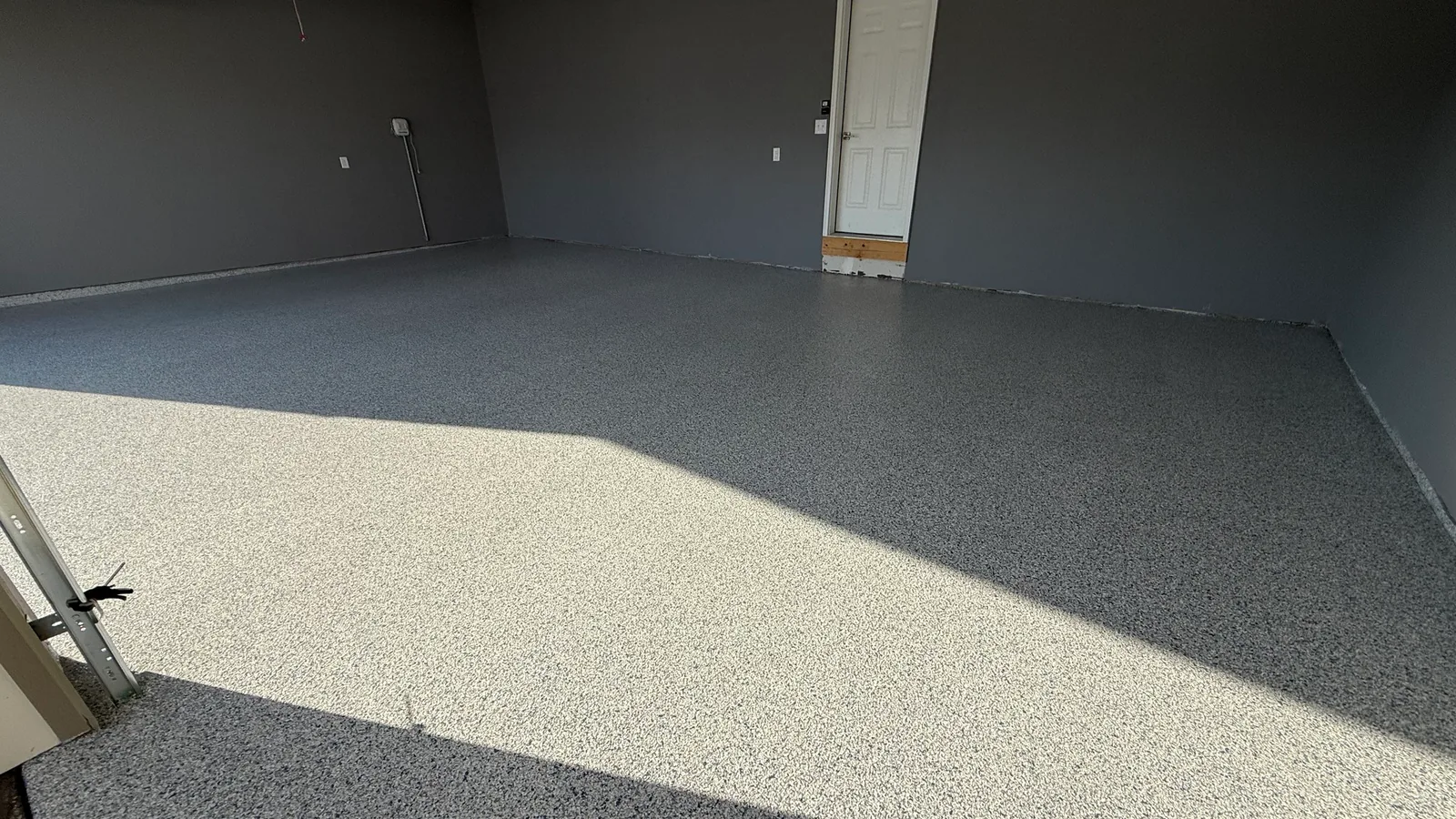
A typical garage gets an epoxy or polyaspartic base coat, full flake and our polyaspartic topcoat. That topcoat is UV stable and hardens in 6 to 8 hours. Most garages are coated in one day. Your free on-site estimate spells out the system, the mil thickness and the repairs for your floor.
See the six steps behind our garage floor coatings, or read why our polyaspartic topcoat systems suit Minnesota winters. Call or text (612) 702-9724.