
Why Do Basement Floor Coatings Fail in Minnesota?
A basement floor coating holds only as well as the slab under it. In Minnesota basements, moisture vapor can move from the damp ground up through the concrete and push a coating loose. Old paint, sealers and a dusty surface also keep a coating from gripping. The fix is to test the slab first, then match the primer and the basement floor coating to the reading.
On price, national cost guides put a professionally installed epoxy floor at about $3 to $12 per square foot. One guide prices a typical 1,000 square foot basement at $2,800 to $11,500. A home-services marketplace’s Minneapolis cost page lists $2 to $12 per square foot for epoxy. These are market numbers, not our price list.
What makes a basement floor coating peel or bubble?
Five conditions can lift a basement floor coating.
- Moisture vapor rising through the slab. University of Minnesota Extension says vapor can move from the wetter ground up through a basement’s concrete floor. In clay soil, it adds, water can wick upward 12 to 20 feet. Maple Grove’s long-range city plan says tight soils there can lead to wet basements, even on hilltop sites. Trapped under a coating, that moisture can break the bond.
- No vapor retarder under an older slab. Minnesota’s residential code calls for a 6-mil plastic vapor retarder, or an approved equal, under a new basement slab. An older slab may sit on a weaker sheet, or on none at all. Concrete industry guidance says the polyethylene sheets once common under slabs have been replaced by stronger ones. One coating maker warns that without a barrier, seasonal ground moisture can climb past a passing test.
- Cold slabs and summer condensation. Extension says warm, humid air condenses on cool basement floors, and many people mistake it for a leak. The average July dew point at the Twin Cities airport is about 63 degrees. Coating makers want the floor at least 5 degrees warmer than the dew point during application. On an average July day, that means a slab of about 68 degrees or warmer.
- Old paint or sealer. Coating makers call for bare, sound concrete, free of old coatings, sealers, curing compounds and densifiers. Those act as bond breakers, so they get ground off first. The calcium chloride moisture test cannot be run over them either.
- A dusty, weak surface. A floor that powders under your feet has a weak top layer, says the ready-mixed concrete industry. Its guide names cold basement slabs finished in humid air as one cause. Flooring adhesives will not bond to a dusting floor, and the fix is removing the weak layer.
That is why we diamond grind every basement slab and test it for moisture before any coating goes down. Slab Lab was founded by a former coating inspector, and these are the prep standards a coating inspector checks for.
How is moisture in a basement slab tested?
Coating data sheets list limits for two ASTM tests, and some accept either one. Both measure the slab only as it is on the day of the test.
- ASTM F1869, the calcium chloride test. A dish of dry calcium chloride sits under a sealed dome on bare concrete for 60 to 72 hours. Its weight gain becomes a rate in pounds of moisture per 1,000 square feet per 24 hours.
- ASTM F2170, the in-situ relative humidity test. Small holes are drilled into the slab, and probes read the humidity inside the concrete. For a slab that dries only from the top, the holes go about 40 percent of the way down. The reading comes about a day later.
What moisture limits do coating makers set?
Each product’s data sheet sets its own limit, and the limits vary widely.
| Product (each from one maker’s data sheet) | Calcium chloride limit (F1869) | Slab humidity limit (F2170) |
|---|---|---|
| Standard 100 percent solids epoxy | 3 lbs | 80 percent |
| Polyurea base coat for a one-day flake floor | 3 lbs | 75 percent |
| Moisture-tolerant epoxy base coat, 16 mils thick | 12 lbs | 85 percent |
| Moisture-mitigating epoxy primer | 25 lbs | 99 percent |
Pounds are per 1,000 square feet per 24 hours. A slab too wet for one product can suit another, so the reading comes before the product choice.
What does a moisture-mitigating primer do?
A moisture-mitigating primer is a first coat made to slow the vapor rising through the slab. The primer in the table is a clear, 100 percent solids epoxy that soaks into the diamond-ground surface. Its maker calls it a negative side moisture vapor barrier, which means it goes on the top of the slab.
The primer goes on at about 16 mils. A flake, solid color or metallic epoxy system then goes over it. It will not bridge cracks, so crack repair comes first.
A primer slows vapor, but it does not stop liquid water. University of Minnesota Extension calls an interior coating a temporary fix for basement water problems. Standing water or seepage is work for a drainage or waterproofing contractor, before any floor coating.
Which basement floor finish fits how you use the room?
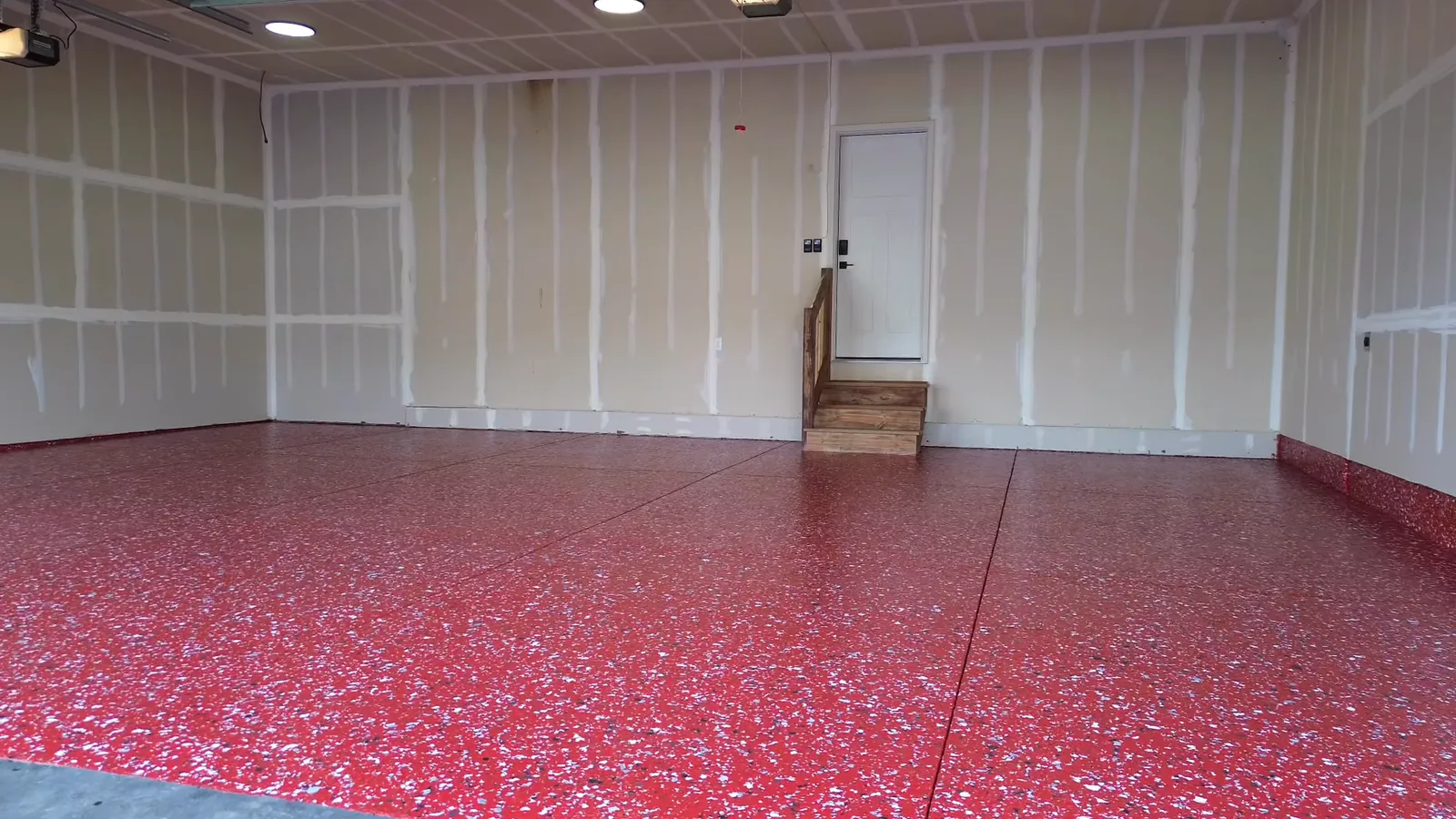
- Family rooms, playrooms and home gyms: a full flake floor. Polymer flakes give the floor an even texture and grip, in two dozen color blends.
- Home bars and entertainment rooms: a metallic epoxy floor. Metallic pigments in clear epoxy are worked by hand into swirls, so every floor is one of a kind.
- Storage rooms, laundry rooms and workshops: a solid color epoxy floor that sweeps and wipes clean. A textured topcoat adds grip where the floor can get wet.
- A modern look with little upkeep: polished concrete. The slab itself is ground and polished to a smooth, dense, low-dust surface with no coating film on top.
- A warm, natural color: stain and seal. The stain colors the concrete itself, and a sealer goes over it.
- A pitted, cracked or uneven slab: concrete repair and resurfacing comes first. Crack and pit repair or an overlay rebuilds the surface before the finish goes down.
What does a basement floor coating cost?
These are 2024 to 2026 market numbers from national cost guides, not our price list.
| Basement floor option | Per square foot | About 1,000 square feet |
|---|---|---|
| Epoxy floor coating, installed | $3 to $12 | $2,800 to $11,500 |
| Thin-coat epoxy or floor paint | $2 to $4 | $2,000 to $4,000 |
| Thick-coat, 100 percent solids epoxy | $10 to $15 | $10,000 to $15,000 |
| Polished concrete, basic finish | $3 to $12 | $7,000 to $12,000 |
| Stained concrete | $2 to $25 | $2,000 to $25,000 |
| Clear acrylic or polyurethane sealer | $1 to $3 | $1,000 to $3,000 |
| Resurfacing or self-leveling overlay | $3 to $7 | Not listed |
| Grinding off an old coating | $2 to $5 | Not listed |
One national guide says moisture and hardness testing adds $50 to $300, more if the slab needs a moisture barrier. A home-improvement guide quotes an installer who puts a moisture barrier at about $1 more per square foot. One polished concrete cost guide says basements with tight equipment access may cost 10 to 30 percent more to polish.
How do you start with your basement floor?
The first step is a look at the slab and a moisture check. We come over from our Otsego base for a free on-site estimate across the Twin Cities metro. The estimate spells out the system, the mil thickness and the repairs for your floor.
A basement is heated space, so the work does not have to wait for summer. See our basement floor coating service, or call or text (612) 702-9724.